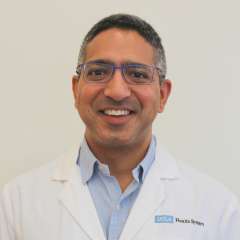
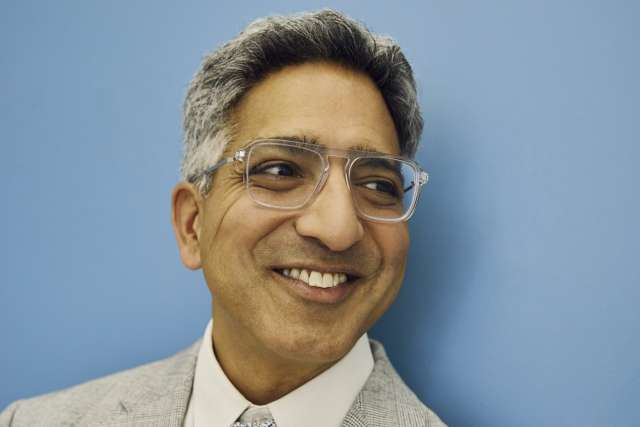
It wasn’t until his second year of residency at Children’s Hospital of Philadelphia that Manish Butte, MD, PhD, found his people.
He was caring for a 6-month-old baby with severe pneumonia, who was only getting sicker. Seeking answers, Dr. Butte explained the infant’s symptoms to specialists called in to consult on the case.
It was his first time meeting with clinical immunologists. He was baffled when, rather than discussing the baby’s symptoms, they instead talked of signaling molecules and cytokines.
“They said that each patient is like a scientific question — and suddenly the light went on,” recalls Dr. Butte, now a professor at the David Geffen School of Medicine at UCLA and division chief of immunology, allergy and rheumatology in the UCLA Health Department of Pediatrics. “I really felt at home with this kind of medicine.”
That early lesson was the foundation for Dr. Butte’s journey to UCLA Health, and to a breakthrough in treating a rare infection caused by the environment.
What is Valley Fever?
Coccidioidomycosis, better known as Valley Fever, develops when humans inhale spores from two species of fungi found in the soils of the arid Southwest, including Central and Southern California.
Most of the 200,000 yearly cases have only mild effects. But in 1% of infections, the fungal invasion leads to life-threatening consequences.
That’s where Dr. Butte’s group has devised a novel method.
Immune modulation reprograms how the body responds to the infection. And the results have been remarkable, from toddlers to seniors.
“Some of the stories are biblical,” says Dr. Butte.
One example: Within four months of treatment, a boy confined to a wheelchair walked again. Another example: after six months of immune modulation, a man who had to catch his breath after walking to his car was completing 50-mile bike races.
“We figured out a molecular pathway of the immune system that went awry,” says Dr. Butte. “We tweaked it, and it worked. They started getting better.”
Each patient is a universe
Until 2018, Dr. Butte had never heard of Valley Fever.
It all began with 4-year-old Abraham Gonzalez-Martinez, whose family brought him 200 miles from his Santa Maria home to UCLA Mattel Children’s Hospital. Valley Fever spread from his lungs to the rest of his body. He was on pain medications and being fed by tube around the clock.
Yet despite receiving the maximum amount of antifungal medicine, little Abraham was dying.
“Our lens was that everyone else who was exposed to the fungus that day wasn’t in our ICU — but this kid is,” says Dr. Butte. “So what went wrong with his immune system that landed him here?”
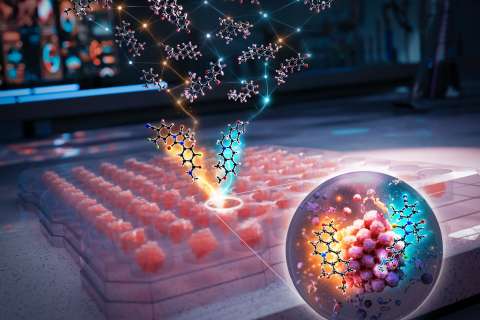
He found the answer in his lab across the street from the hospital. Dr. Butte’s team used new tools of genome and transcriptome sequencing to analyze the molecular pathways that were turned on in Abraham’s T lymphocytes, a type of immune cell.
Abraham’s immune system was launching the wrong response to the Valley Fever infection: instead of Type I, meant for fungi and other microorganisms, his response was Type II, a response for parasites and allergies.
Dr. Butte’s team theorized that blocking the Type II response would induce Abraham’s immune system to reprogram itself to the correct way of fighting the fungal infection.
His colleague Maria Garcia-Lloret, MD, a professor of pediatric allergy and immunology at the medical school, proposed the medication dupilumab, which was prescribed to treat eczema and asthma.
Since the medication was then newly approved by the U.S. Food and Drug Administration, getting his hands on it was tough. The team’s allergy nurse, Patricia Eastman, secured a makeshift supply from a community allergist — just enough to test on Abraham’s cells.
They reprogrammed Abraham’s T cells to Type I immunity within a week.
Expanding treatment
The overall number of Valley Fever cases continues to rise, driven by the hotter, drier conditions of a changing climate.
Rainy winters foster the fungi’s growth. Drought, agriculture and construction work allow the spores to emerge from the soil and float through the air. Global warming will also likely drive the pathogen into other parts of the U.S., leading to more widespread infections.
Since Abraham was cured, Dr. Butte has treated and studied hundreds of patients with severe Valley Fever, many of whom were flown in from other regions of California. Valley Fever is now at the center of his work.
In 2022, the National Institute of Allergy and Infectious Diseases awarded a five-year, $8.4 million grant to launch a Valley Fever research center, with Dr. Butte as principal investigator.
The next big undertaking is to sequence the genomes of every single patient and look for patterns. In 200 patients already sequenced, several have a genetic mutation that explains the skew to Type II immunity.
But not all the patients have that mutation, making their immune response a mystery. Complicating matters is an overall lack of knowledge about the genes that control the immune system. Environmental influences such as diet and air pollution may also be influencing the immune response.
Beyond the skewing of the immune response, Dr. Butte is also investigating a new theory for why the fungus ravages the body. His group was the first to find “exhausted” T cells in most Valley Fever patients, like those found in some cancers.
These inactive T cells can be reactivated by a certain class of immunotherapy medications. The Butte Lab found that the same drugs also prodded exhausted T cells to respond to the fungal infection.
The next step is to test the drugs in patients with severe Valley Fever.
‘What I’m here for’
A few months after Abraham’s treatment began, Dr. Butte was surprised by his little patient. Not only was Abraham out of bed, but he was playing hide-and-seek in the voluminous curtains in his room, his tiny feet visible under the fabric.
“It was really magical to experience Abraham’s playfulness after he had been so ill,” Dr. Butte remembers.
He credits his work on Valley Fever with connecting him to his patients, their families, Valley Fever advocates and other passionate collaborators in a way that he’s come to cherish.
“I used to think primarily about ‘solving the puzzle,’ figuring out the patients’ signaling pathways, their genomes and their T cells, focusing on restoring the health of our patients’ immune systems. But I’ve come to realize that a deep connection to their biology opens a close, emotional connection with patients, families and other scientists, which really motivates me,” he says.
“This is what I’m here for.”