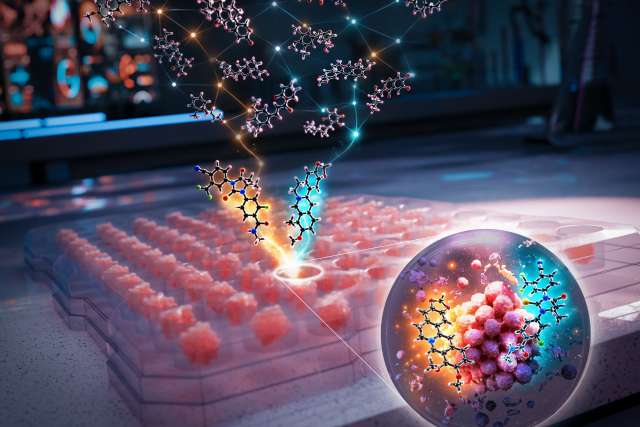
UCLA investigators have developed a new artificial intelligence-based platform that could help scientists identify promising drug combinations to overcome treatment resistance in cancer.
The platform, called MAESTRO and described in Advanced Science, uses large language models, or LLMs, to analyze scientific knowledge about how drugs work and the biological pathways cancer cells use to survive treatment. The system evaluates potential drug combinations, ranks the most promising candidates and generates biological explanations that researchers can test in the laboratory.
To identify drugs that could help overcome treatment resistance in prostate cancer, the researchers used MAESTRO, short for Mechanistic Augmentation and Ensemble Selection for Therapeutic Ranking Optimization, to evaluate thousands of natural products. The platform identified several compounds that could potentially enhance the effectiveness of enzalutamide, a drug originally discovered and developed at UCLA that is commonly used to treat advanced prostate cancer.
"Developing drug combinations currently relies on either brute-force screening or researchers hypothesizing potential candidates based on existing literature," said Neil Lin, PhD, an associate professor of mechanical and aerospace engineering and bioengineering at the UCLA Samueli School of Engineering and senior author of the study. “It is time-consuming, and it can still be difficult to capture the complex interactions among multiple biological pathways. MAESTRO could substantially accelerate this process. By integrating existing biomedical knowledge, it can identify drug combinations that have a clear biological rationale and are most appropriate for experimental testing.”
The researchers focused on prostate cancer, where treatment resistance remains a major challenge. Prostate cancer cells often depend on androgen receptor signaling to grow. Drugs such as enzalutamide work by blocking this signaling, but cancer cells can eventually adapt by activating alternative pathways that allow them to survive, leading to treatment resistance.
Combining drugs that target these escape routes could potentially help overcome resistance. However, with thousands of possible compounds and multiple interconnected biological pathways involved, identifying effective combinations remains a major challenge.
Although AI has shown promise in predicting drug combinations, many existing approaches require large amounts of experimental training data and provide limited insight into why certain drugs might work together. The UCLA team designed MAESTRO to address these limitations.
Researchers supplied the LLM with scientific information relevant to the task, including prostate cancer biology, resistance mechanisms and known drug actions. The model then evaluated how those mechanisms might interact with androgen receptor blockade and ranked compounds as potential partners for enzalutamide.
Rather than relying on a single prediction, the researchers had the model evaluate each candidate more than 100 times. They then looked at how highly each compound ranked and how consistent those rankings were across repeated evaluations. Compounds that consistently received high rankings were considered the most promising candidates.
The researchers used the platform to evaluate 3,592 natural products for their potential to work with enzalutamide. The system identified 150 high-confidence candidates for testing in 3D prostate cancer spheroids. These tumor-like clusters can better capture some aspects of cancer biology than cells grown in traditional flat layers. The researchers also supplemented the models with oxygen to reduce cell death caused by oxygen deprivation, allowing them to more accurately measure how the drug combinations affected cancer cells.
Of the 150 compounds tested, 23 showed evidence of synergy with enzalutamide, meaning the combination produced a greater effect than expected from the individual compounds. Further testing identified berberine, a naturally occurring compound found in several plants, as a particularly promising candidate. The combination of berberine and enzalutamide showed consistent synergy across four prostate cancer models with different mechanisms of treatment resistance.
“Berberine was not an obvious candidate because it affects several biological pathways, making it difficult to predict how it might work with other drugs,” said James C.H. Lo, who was a postdoctoral student in the bioengineering department at UCLA when the work was conducted and first author of the study. “What surprised us was that the combination showed consistent synergy across all of the prostate cancer models, despite their different resistance mechanisms. This is where MAESTRO demonstrated its strength, helping us identify a promising combination that might have been overlooked by examining each pathway separately.”
The researchers also investigated whether the biological effects of the combination matched the mechanism suggested by MAESTRO. They found that adding berberine to enzalutamide increased the activity of AMPK, a pathway involved in regulating cellular energy and stress, while suppressing mTORC1 signaling, which plays an important role in cell growth and survival. The combination was also associated with increased cellular stress and reduced DNA replication and cell-cycle progression.
The findings suggest that berberine and enzalutamide could be a promising combination for further research, particularly in prostate cancers that have developed resistance to treatment. The researchers also noted that the AMPK-mTORC1 mechanism identified in the study could help guide the development of other drug combinations designed to overcome resistance.
The researchers plan to further evaluate the combination in patient-derived tumor models and animal studies. They also hope to expand MAESTRO by incorporating additional types of biological data and applying the platform to other drug combinations, resistance mechanisms and cancer types.
“Large language models can be more than conversation or text-generation tools,” said Lin, who holds a joint faculty appointment in urology at the David Geffen School of Medicine at UCLA and is an investigator at the UCLA Health Jonsson Comprehensive Cancer Center. “With appropriate scientific design and validation, they can support drug discovery and generate hypotheses that can be tested experimentally.”
Other senior authors on the study include Robert Damoiseaux, PhD, professor of molecular and medical pharmacology and bioengineering and director of UCLA's Molecular Screening Shared Resource at the California NanoSystems Institute; Cho-Jui Hsieh, associate professor of computer science at the UCLA Samueli School of Engineering; Tanya Stoyanova, PhD, associate professor of molecular and medical pharmacology and urology at the David Geffen School of Medicine at UCLA; and Andrew Goldstein, PhD, professor of molecular, cell and developmental biology and urology at the David Geffen School of Medicine at UCLA.
Lin is also a member of the Broad Stem Cell Research Center, the California NanoSystems Institute and the Institute for Quantitative and Computational Biosciences at UCLA.