Vision Rehabilitation
The UCLA Vision Rehabilitation Center was established to provide rehabilitation to maximize visual function and quality of life of patients with low vision. The Center is under the direction of Ava K. Bittner, OD, PhD, director and Smotrich Family Optometric Clinician-Scientist Chair.
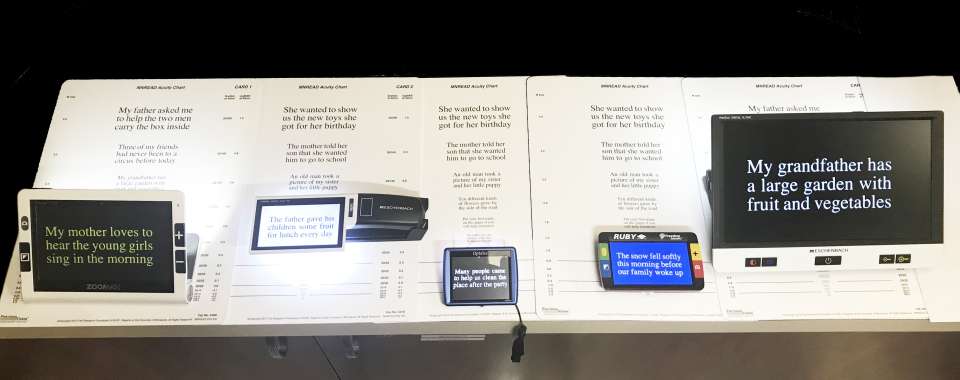
There are a wide variety of portable digital video magnifiers to enhance contrast and provide magnification for near reading tasks, which are available to evaluate at the Vision Rehabilitation Center, some of which are shown above.
The Center provides assistance in the form of patient consultation and training, including evaluation with the latest visual assistive devices that can help patients improve their visual functioning. The Center utilizes a wide array of technologically advanced devices, such as magnifiers, telescopes, and digital and computer technology. Customized for each patient’s individual needs, services may range from simple solutions to specialized approaches. There are considerations for enhanced illumination through task lighting or filters to help with light sensitivity due to glare. When appropriate, referrals are provided to assist independent living through additional services, such as occupational therapy or orientation and mobility training.
Faculty at the UCLA Vision Rehabilitation Center are also conducting research studies and pioneering novel ways to help people with vision loss. Visual disability is reduced with multiple training sessions to help people improve their use of assistive devices (e.g., magnifiers). Resource efficient and convenient ways are needed to provide this training and reduce barriers in accessing care. We have developed a system using tele-rehabilitation that involves videoconferencing to provide at-home training remotely with your doctor at the Vision Rehabilitation Center. The Center is conducting an NIH-sponsored multicenter trial to evaluate how this new approach can improve reading ability with their magnifiers.
New technology includes options for free visual assistive mobile apps for smartphones and tablets that can be used for many indications, including reading or support with accomplishing various visual tasks. Training to learn to use these apps and digital device accessibility is offered by our vision rehabilitation providers. Ava Bittner, OD, PhD, Jennie Kageyama, OD, Eric Yoshinaga, OD, Christie Chen, OD, and Kayla Gan, OTD, look forward to working with you to help accomplish your important goals.

UCLA Low Vision Support Group
New UCLA Low Vision Support Group
We are very excited to be able to offer the UCLA Low Vision Support Group to provide emotional and functional support to adults coping with sudden or progressive vision loss.
The Support Group is coordinated by our Stein Eye Institute Vision Rehabilitation Center faculty Drs. Ava Bittner and facilitated by Janice Goldhaber, a licensed psychotherapist in private practice, who specializes in working with individuals with visual impairment, blindness, and other disabilities.
Goals of the support group are:
1) To provide practical guidance for navigating the world with impaired vision
2) To provide strategies and support for coping with the emotional impact of sight loss
3) To create an open forum for sharing experiences relating to vision loss and connecting with others with similar conditions and experiences
These will be ZOOM meetings held every other month on Wednesdays from 4-5:30 pm. The ZOOM link will be provided to patients once they join the meeting list.
Please feel free to print out the program flyer and distribute to any of your patients who may be interested.
For further information please feel free to call 310-825-6323 or email [email protected]