
Thyroid Radiofrequency Ablation (RFA)
Find Your Care
We deliver effective, minimally invasive treatments in a caring environment. Call 310-267-7838 to connect with an expert in endocrine surgery.
Radiofrequency Ablation (RFA) at UCLA
UCLA Health Endocrine Surgery & Interventional Radiology · Last reviewed: January 2025 · (310) 267-7838
UCLA Health's Thyroid Radiofrequency Ablation (RFA) Program offers a minimally invasive, non-surgical treatment for benign thyroid nodules and selected other thyroid conditions. During the outpatient procedure, a small needle electrode is inserted into the nodule under ultrasound guidance; heat from the needle tip destroys the tissue and progressively shrinks the nodule — with no incision, no scar, no general anesthesia, and same-day discharge. Most patients return to normal activities within 24–48 hours and do not need thyroid hormone medication afterward. The program is led by endocrine surgeons Dr. James Wu and Dr. Masha Livhits and interventional radiologists Dr. David Lu, Dr. Michael Douek, and Dr. Gary Tse, who together perform more than 500 thermal ablation procedures annually at UCLA Health.
Thyroid Nodule Radiofrequency Ablation (RFA)
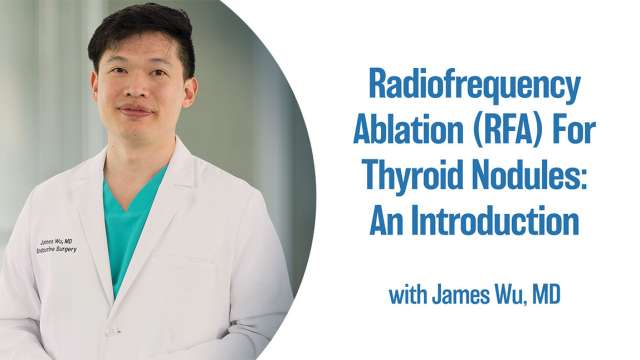
Video: Dr. James Wu, UCLA Health endocrine surgeon, provides an overview of thyroid radiofrequency ablation (RFA), a new minimally invasive treatment for benign thyroid nodules.
| ~1 hr | Same day | 24–48 hrs | 50–80% | No scar | 500+ |
|---|---|---|---|---|---|
| Procedure duration |
Discharge | Typical recovery |
Avg. nodule volume reduction at 1 year |
No surgical incision |
Thermal ablations /year at UCLA |
About the UCLA Thyroid RFA Program
The UCLA Thyroid RFA Program is a collaboration between UCLA Interventional Radiology, Endocrinology, and Endocrine Surgery — bringing together three specialties to evaluate each patient and select the best treatment. Endocrine surgeons Dr. James Wu and Dr. Masha Livhits and interventional radiologists Dr. David Lu, Dr. Michael L. Douek, and Dr. Gary Tse have extensive experience in thermal ablation across multiple organs. UCLA Health performs more than 500 thermal ablation procedures annually.
Who Is a Candidate for Thyroid RFA?
✓ Good candidates
- Biopsy-proven benign solid thyroid nodules causing pressure or swallowing symptoms
- Benign nodules causing cosmetic concerns (visible neck bulge)
- Autonomously functioning thyroid nodules (alternative to surgery or radioactive iodine)
- Selected small thyroid cancers or recurrent nodules in patients who cannot have surgery
✗ Not candidates
- Pregnant patients
- Patients with cardiac pacemakers
- Nodules located adjacent to the vocal cord nerve, esophagus, or major blood vessels
- Predominantly cystic (fluid-filled) nodules — ethanol ablation is preferred
Thyroid RFA vs. Thyroid Surgery: Side-by-Side Comparison
| Factor | Thyroid RFA | Thyroid Surgery (Thyroidectomy) |
|---|---|---|
| Anesthesia | Local (mild sedative optional) | General anesthesia |
| Incision / Scar | None | Neck incision (typically 3–6 cm) |
| Hospital stay | Outpatient, same-day discharge | 1–2 days inpatient (or outpatient) |
| Typical recovery | 24–48 hours | 1–2 weeks |
| Thyroid function preserved? | Yes — thyroid medication rarely needed |
Partial or total removal; medication often required |
| Nodule recurrence | Possible; re-treatment available | Very low (tissue removed) |
| Suitable for cancer? | Selected low-risk, non-surgical candidates only |
Standard of care for most thyroid cancers |
Comparing Thyroid Ablation Options
| Method | Best for | Notes |
|---|---|---|
| Radiofrequency Ablation (RFA) | Solid or complex nodules | Preferred method for solid benign nodules; extensive evidence base |
| Ethanol (Alcohol) Ablation | Predominantly cystic (fluid-filled) nodules |
Simple, effective for fluid-filled cysts |
| Laser Ablation | Small solid nodules | Less data than RFA; generally considered inferior for larger nodules |
| Cryoablation | Varied | Less commonly used in thyroid; RFA generally preferred |
Frequently Asked Questions about Thyroid RFA at UCLA
What exactly happens during a thyroid RFA procedure?
During thyroid RFA, a physician inserts a thin needle electrode through the skin of the neck directly into the thyroid nodule, guided by real-time ultrasound imaging. Radiofrequency energy is delivered through the needle, generating heat at the tip. This heat destroys the nodule tissue from the inside out. The procedure requires only local anesthetic (numbing the skin and neck), takes approximately one hour, and involves no cuts or stitches. Patients leave with a small bandage.
How much will my thyroid nodule shrink after RFA?
Nodule shrinkage begins approximately one month after the procedure and continues progressively. Published clinical studies report an average volume reduction of 50–80% at 12 months for benign solid nodules. Complete disappearance of the nodule is not expected, but symptomatic relief and cosmetic improvement are typically significant. Very large nodules may require more than one RFA session.
Will I need to take thyroid hormone medication after thyroid RFA?
No — this is one of the primary advantages of RFA over surgery. Because the procedure destroys only the target nodule and preserves the surrounding thyroid tissue, thyroid hormone production is maintained. Patients undergoing thyroid RFA at UCLA Health typically do not need to start thyroid replacement medication as a result of the procedure.
What is the recovery like after thyroid RFA?
Thyroid RFA is an outpatient procedure. Patients are discharged the same day and most return to normal daily activities within 24–48 hours. Some mild discomfort, neck soreness, or bruising at the needle site may occur and can be treated with over-the-counter pain medication (such as acetaminophen or ibuprofen). There is no surgical incision and no scar.
Is thyroid RFA safe? What are the risks?
Thyroid RFA is considered safe when performed by experienced physicians. Major complications are uncommon. Potential risks — which are reviewed in detail during your consultation — include temporary voice changes (if the nerve to the vocal cord is irritated), skin burns, infection, or incomplete ablation requiring a second treatment. The UCLA program performs more than 500 thermal ablation procedures per year across multiple organs, reflecting a high level of institutional experience.
Does insurance cover thyroid RFA?
Insurance coverage for thyroid RFA varies by plan and is evolving as the procedure becomes more widely adopted. UCLA Health's billing team can verify your specific coverage prior to your procedure. Call (310) 267-7838 or contact the Endocrine Center for a pre-authorization review.
What is an autonomously functioning thyroid nodule, and can RFA treat
An autonomously functioning thyroid nodule (also called a "hot nodule") produces thyroid hormone independently of the body's normal regulatory signals, sometimes causing hyperthyroidism. Traditional treatments include surgery or radioactive iodine. Thyroid RFA is an effective alternative for eligible patients who prefer to avoid these options. Eligibility is determined on a case-by-case basis at UCLA Health.
Can thyroid RFA treat thyroid cancer?
Surgery remains the standard of care for the large majority of thyroid cancers. However, thyroid RFA may be appropriate for a carefully selected subset of patients: those with small primary thyroid cancers or small recurrent thyroid cancers (typically in lymph nodes) who are not surgical candidates due to other medical conditions, or who have declined surgery after thorough counseling. These cases are reviewed by the full multidisciplinary team at UCLA Health before RFA is recommended.
How do I get evaluated for thyroid RFA at UCLA Health?
Call (310) 267-7838 to schedule a consultation with UCLA's endocrine surgery team, or request an interventional radiology consultation through the UCLA Interventional Radiology department. Patients are evaluated by a multidisciplinary team — an interventional radiologist, an endocrinologist, and an endocrine surgeon — to determine whether RFA is the best option. A referral from your primary physician is helpful but not always required.
Schedule a Consultation
Our multidisciplinary team will evaluate whether thyroid RFA is right for you.
Medical review: Content reviewed by Dr. James Wu, MD, Endocrine Surgeon, UCLA Health. Last reviewed January 2025.
Sources: Korean Society of Thyroid Radiology (KSThR) RFA guidelines; American Thyroid Association treatment guidelines; UCLA Health Endocrine Surgery Program clinical data.