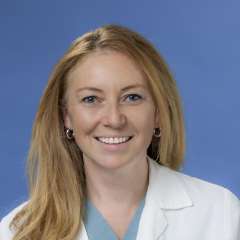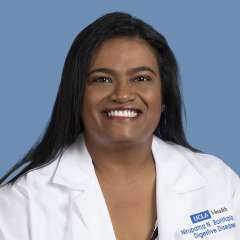
Active inflammatory bowel disease (IBD) in pregnancy poses risks to both patients and their babies. In response, UCLA Health has strengthened its Maternal Fetal Health program with an IBD-specific clinic, co-led by Ilina Pluym, MD, assistant clinical professor of obstetrics and gynecology in the division of Maternal Fetal Medicine, and Nirupama Bonthala, MD, director of Women’s Health in IBD. The program combines the heft of UCLA Health’s interdisciplinary medical resources with its expansive research capability to deliver optimum care and outcomes.
Teaming up obstetricians and gastroenterologists, the clinic proactively works with patients with IBD (specifically ulcerative colitis or Crohn's disease) throughout preconception, pregnancy and postpartum. IBD typically occurs during the peak of reproductive years, and if left uncontrolled, “… can create risk for an abnormal slowing of growth of the baby, preterm delivery, preeclampsia, a mother who feels sick and more,” explains Dr. Pluym. However, when steps are taken to control the disease, patients can expect a normal, healthy pregnancy.
“The Inflammatory Bowel Disease in Pregnancy program that integrates expertise from both teams to provide personalized and holistic care, is just one example of the gold standard that we aim to achieve throughout the UCLA Department of Obstetrics and Gynecology, says Christina S. Han, MD, interim chair of the department and division director of Maternal Fetal Medicine. “This model is implemented in all of our other clinical programs and is constantly being improved based on patient feedback. Our goal is to ensure that patients receive seamless evidence-based care throughout the reproductive spectrum."
Patient intake
Identifying an IBD strategy for patients prior to pregnancy whenever possible is important. Dr. Pluym says this step is especially crucial if a patient has a very complex disease beyond the comfort zone of their regular gastroenterologist or obstetrician.
Preconception consultations allow UCLA Health’s specialized team to assess the patient’s health and make improvements before pregnancy occurs, lay out a plan for the course of the pregnancy, determine necessary follow-ups and form a backup plan in case the patient’s disease becomes active during pregnancy.
“We recommend not only that the mother feels well and is in clinical remission, but we also want endoscopic remission. That can be determined through a colonoscopy examination a year or two prior to pregnancy,” advises Dr. Pluym.
She notes that connecting a patient with the IBD program prior to pregnancy has another important benefit: the establishment of a lifeline access to a specialized center in the event a patient needs more help than their regular obstetrician or gastroenterologist can provide.
Patients coming into the IBD program typically begin with a preconception virtual visit with Dr. Pluym and one with gastroenterologist Dr. Bonthala. Once pregnant, patients are seen by Dr. Bonthala from monthly to every trimester, depending on how active their disease is, and every trimester by Dr. Pluym for an ultrasound consultation.
While all pregnant people have two to three ultrasounds at UCLA Health during their pregnancy, patients with IBD always get that third trimester ultrasound to check on the growth of the baby.
“When a woman has active disease, her immune system is also very actively working to fix the issues in the colon, and that raises concerns that some of the energy might be taken away from growing the baby and putting it at risk for growth restriction,” says Dr. Pluym.
Progress through research
UCLA Health maintains expansive and active research capabilities which serve to further reinforce the Maternal Fetal Health IBD program.
Data collected on all patients participating in the program helps identify and inform related research topics. Dr. Pluym notes UCLA Health will be presenting research at the Society for Maternal-Fetal Medicine Conference in Las Vegas in February 2026 on how fetal growth is affected in patients with IBD, depending on if they are anemic or not.
“Anemia is very common, both in pregnancy and in IBD,” she says. “When compounded together, is it even more detrimental to the baby's growth? That is the concern. We also are doing research about rates of preeclampsia in women with IBD.”
Dr. Pluym says an “even bigger research vision” includes the team’s continuing contribution to a national registry of women with IBD and the recruitment of patients for a nationwide cohort of women who are on somewhat rare IBD medications that are just starting to be developed and used.
“We are contributing data to the growing literature about the safety of many of these biologic medications in pregnancy,” Dr. Pluym explains. “The old-school thinking that all medications should stop the moment a woman becomes pregnant is wrong. Most of these medications are safe and can be continued.”
She encourages anyone who may be in doubt about the safety of patients’ medications “… to reach out to us so we can go through the medications and counsel on what patients can and cannot take. It is actually worse when medications are stopped cold turkey. If the disease flares, outcomes are worse.”
As for preeclampsia in women with IBD, she says, “In our UCLA cohort, we found that hypertensive disorders of pregnancy occurred in over one in five pregnancies among patients with IBD.”
In addition to working closely with patients, clinic team members are committed to educating referring gastroenterologists and obstetricians so that all care providers are equipped with the same relevant and leading-edge information pertaining to maternal fetal health and IBD. It is one more essential step UCLA Health employs to drive the most comprehensive care and best possible patient outcomes.
Related articles
UCLA OB/GYN global health initiatives spark learning, innovation and training
At UCLA Health, a cancer care program that goes beyond the curative