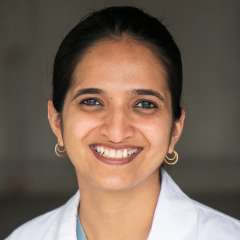
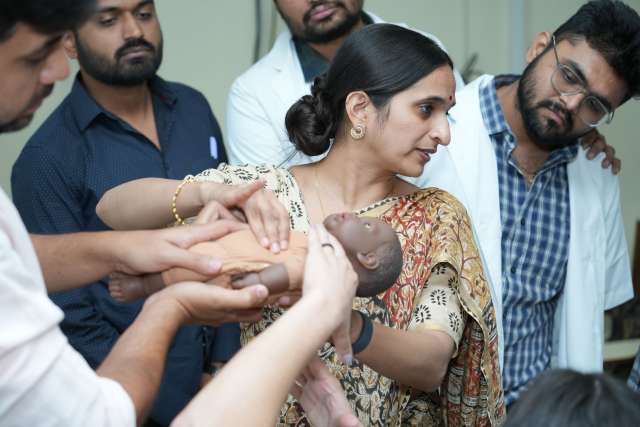
Aparna Sridhar, MD, has seen first-hand how the UCLA Department of Obstetrics and Gynecology’s global health partnerships have strengthened clinicians’ ability to provide empathetic, respectful and culturally attuned care for California’s diverse patient population.
For Dr. Sridhar, director of the Global Reproductive health Alliance for Collaborative Engagement (GRACE) program, the goal of this “global learning” is to advance reproductive health through equitable, collaborative partnerships in education, research and clinical innovation.
“For UCLA OB/GYN’s doctors, residents and fellows, these global engagements provide invaluable insights into caring for patients from diverse cultural backgrounds with different models of reproductive and maternity care – lessons that are deeply relevant in Los Angeles, a city whose population represents pretty much every region of the world,” she said.
Becoming culturally attuned to diverse populations
In India, for example, they observed childbirth practices such as specific postpartum diets for new moms that incorporate foods that help produce more milk after delivery and steer clear of foods that cause abdominal discomfort.
Some cultures use a practice known as “belly-binding,” in which a long cotton cloth (often a sari) is wrapped around the abdomen soon after delivery. This wrap is traditionally believed to support uterine recovery, stabilize the abdominal wall and encourage gentle muscle realignment, similar to the concept of postpartum abdominal binders that are commonly used in the U.S.
Observing how maternal care is delivered in other cultures also helps trainees understand diversity in care, equipping them to better apply such understanding in the patient populations they end up serving here.
“You get to see how there is this huge influence of culture in childbirth practices and postpartum traditions,” Dr. Sridhar said. “When we came back from these trips, it helped us have a deeper appreciation for how much culture is still involved in obstetrical care. It helps us understand that quality of care is not one-size-fits-all, but one that takes into account the cultural preferences, rituals and people’s lived experiences.”
Dr. Sridhar said they get to apply this “cultural humility” acquired from their global learning here in Los Angeles, when they care for pregnant patients who have their own cultural preferences and traditions around childbirth and postpartum care.
Sharing experiences to promote learning and innovation
The global programs also facilitate a virtual learning exchange between California and India through various partnerships. UCLA Health’s partnership with the Federation of Obstetric and Gynecological Societies of India, for instance, resulted in virtual discussions about guidelines in both countries when it comes to diagnosis and treatment.
“We were not teaching one another, but we were sharing our experiences and found so many similarities,” Dr. Sridhar said, adding that the differences were mostly because of available resources and variations in health care systems. “There was a lot of learning that happened as a result of this exposure to other health systems, which made us think about the people here in California who have issues with access to health care.”
The other such partnership, Dr. Sridhar said, was with the South Asian Federation of Obstetrics and Gynecology, which includes member societies from Afghanistan, Bangladesh, India, Nepal, Pakistan and Sri Lanka. In addition to virtual discussions, UCLA Health partnered with Stanford University to run virtual simulations of obstetric emergencies.
“This was a significant innovation in terms of understanding crisis situations such as hypertensive emergencies in pregnancy,” she said. “A virtual scenario, for example, might involve someone coming in with a seizure and how we respond to that. These exchanges also helped us learn about how things can be done in low-resource settings.”
Dr. Sridhar said it was heartwarming to see how patients could be cared for with respect and dignity even when resources are scarce.
“They take care of patients with the same passion by using the best possible resources to handle the emergency situations and still provide the best care they can,” she said.
Global learning is an essential investment
UCLA Health’s OB/GYN service also has had a significant presence in Uganda. Christopher Tarnay, MD, clinical professor of Obstetrics and Gynecology at the David Geffen School of Medicine at UCLA, has led a transformative global health initiative in Uganda in partnership with Medicine for Humanity, a nonprofit organization in the area of obstetric fistula care and pelvic floor disorder treatment.
Dr. Tarnay, since 2008, has served as medical director and president of the group, leading a long-standing collaboration with Mbarara Regional Referral Hospital and the University of Mbarara, helping establish the Center for Gynecologic and Fistula Care in 2018. This surgical and recovery facility has become a regional hub for fistula repair and training. The partnership has helped UCLA Health OB/GYN residents, fellows and clinic staff to gain hands-on experience in advanced gynecologic surgery while contributing to meaningful cross-cultural exchange. Participants have been able to work alongside Ugandan colleagues in the operating room and in community outreach settings.
Dr. Sridhar said this impactful program has served as a model for academic-clinical partnerships that have been able to successfully blend service, surgical training and capacity-building in low-resource settings. She said through the GRACE program, she and her team are hoping to continue these initiatives and add more in the future. Their next project will be in Zimbabwe, where UCLA Health gynecologists will use augmented reality glasses to train remote-area physicians in obstetrical emergency services.
Maternal mortality is a pressing health challenge in sub-Saharan Africa which, in 2020, accounted for nearly 70% of all maternal deaths worldwide. In Zimbabwe, the maternal mortality rate is alarmingly high, at 358 deaths per 100,000 live births compared to 18.6 per 100,000 in the United States, according to the World Health Organization.
A major contributor to these disparities, said Dr. Sridhar, is the lack of access to high-quality emergency obstetric and newborn care, particularly in rural and underserved areas. GRACE’s project proposes an innovative solution – using augmented reality or AR smart glasses to facilitate remote mentorship during obstetric emergencies. Mentors will be able to see and hear what rural providers experience in real-time and provide clinical support without having to travel thousands of miles, she said.
“It’s a big innovative step because we’ll get to see if these newer technologies can help solve these problems where rural health providers are unable to leave their practice and come to an urban center to get trained,” Dr. Sridhar said.
The beauty of implementing these initiatives in low- and middle-income countries, she said, is to return to California and see a different version of that problem here at home.
“We have maternity care deserts in California with maternity care units being shut down,” Dr. Sridhar said. “So, the problems are similar even if the context is different. Ultimately, the goal is that your ZIP code should not dictate the type of care you receive.”
She believes in the mission of the GRACE initiative and the meaningful innovations and breakthroughs the program has had in a short time.
“Global learning is not a luxury,” she said. “It’s an essential investment in excellence.”
Related articles
At UCLA Health, a cancer care program that goes beyond the curative