
Artificial intelligence in healthcare is not new. It was back in June 1975 that the National Institutes of Health convened a workshop so scientists could trade ideas about clinical diagnosis models developed at several universities.
Fast forward 50 years and using AI in medicine is now practical. Healthcare data is digital and computing capabilities are greatly advanced from the mid-’70s.
AI is rapidly expanding into health systems across the country. Its increasing sophistication – machine learning, deep learning and foundation models – is driving its thoughtful incorporation into UCLA Health, where it also serves as a tool for innovation.
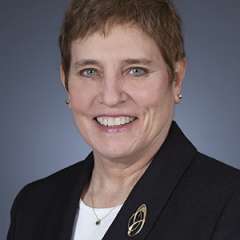
“AI can be a positive force, but we need the human in the loop,” said Katherine P. Andriole, PhD, the inaugural associate dean for health AI strategy and innovation at the David Geffen School of Medicine at UCLA. “With AI tools we can transform how care is delivered in many ways.”
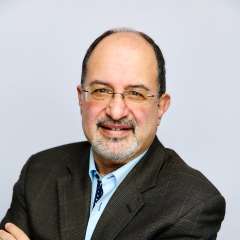
Dr. Andriole and Paul J. Lukac, MD, the inaugural chief artificial intelligence officer at UCLA Health, are leading UCLA Health’s AI strategy in clinical operations, research and education. They are cautious optimists, stressing the critical role of the human clinician as a guardrail for the new technology.
As healthcare transforms itself in the next 10 to 15 years, UCLA Health is playing an integral role in establishing national standards in the use of AI and maintaining the trust of the community.
Clinical care
For Dr. Lukac, the main focus in implementing AI is improving patient outcomes and experience.
“I am continually thinking about ensuring that our use of AI is safe and responsible, and our models are working well and equitably across patient populations,” he said.
His team recently deployed a new, more intelligent chatbot on the health system’s website that provides patients with rapid, targeted information, such as the name, number and schedule for the closest specialist. Dr. Lukac said the next iteration will allow direct scheduling of appointments.
The patient experience is also enhanced by a “scribe” for physicians that turns the audio of a doctor-patient visit into a clinical note. The technology already has about 1,000 users within the health system. It not only cuts down on the physician’s time taking and revising notes, but allows for more face-to-face conversation with a patient.
“It really restored why we all go into medicine, which is you actually want to talk to the person in front of you, and not type on a keyboard,” said Dr. Lukac.
Radiology, perhaps the specialty most transformed by AI, has a full suite of applications.
One is a triaging tool that does a first-pass overview of an image, for example a head CT to check a patient for a stroke in the emergency room. If it identifies something suspicious, it pushes the image to the top of a radiologist’s reading queue and “that patient can get care that much faster,” said Dr. Lukac.
AI at UCLA Health is sourced from a variety of developers.
About 40% comes from a group of data scientists in the AI development lab who build bespoke models to address an issue unique to UCLA Health. In addition, the electronic health record system Epic has quite a few AI options embedded, such as quickly summarizing a patient’s medical chart. Programs from outside vendors make up the remaining third.
Everything is vetted by the UCLA Health AI Council to ensure the ethical and responsible use of AI, as well as data security and privacy.
“UCLA Health is the perfect environment to make change with AI in a way that not only directly impacts our patients, but also makes our providers’ jobs a bit easier,” said Dr. Lukac.
Research
With AI’s capabilities for deep learning and the development of large language models, its applications in clinical research have greatly expanded.
Dr. Andriole, who is also director of the Center for AI and Smart Health, aims to facilitate researchers by giving them access to foundation models and other tools to work with the vast amounts of clinical data generated within UCLA Health systems.
Partnerships with industry scientists will be particularly beneficial, Dr. Andriole believes, given the cost of the tools, the high intensity of computation that is needed and industry’s continued innovation.
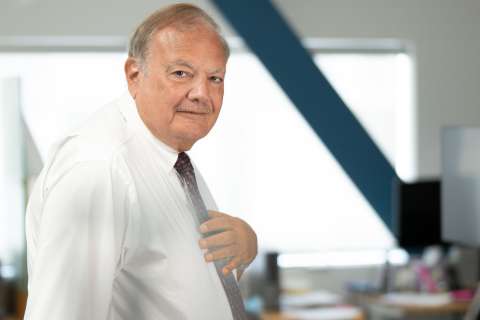
One physician-scientist who is already incorporating AI into his work is Arash Naeim, MD, PhD, senior associate dean for clinical research at the medical school.
He is testing conversational AI agents to see if they can assess older patients before a visit to the clinic. This would be especially applicable to older patients who have cancer and must be evaluated for their geriatric state before beginning aggressive treatments such as chemotherapy.
“Oftentimes, it's very difficult to do that in a busy clinical visit,” said Dr. Naeim, a member of the UCLA Health Johnsson Comprehensive Cancer Center. “So is it possible for an older patient to converse with an AI agent which can collect that?”
Though the human connection is lost with the agent, a patient can decide when and for how long they choose to spend working through the assessment questions. The other benefit is that they can ask questions when they don’t understand something.
“I might be interested in whether an older patient is able to lift 10 pounds of weight,” said Dr. Naeim. “So they can ask the AI agent for examples of things that weigh 10 pounds, and the AI agent might say it's equivalent to two bags of groceries.”
UCLA recently submitted a grant to study the autonomous management of patients with congestive heart failure. AI would use the data from wearables and implanted devices to monitor the patient continuously and may also flag future adverse events.
“Is it going to be like autonomous driving? And how much faith do you have to have in its safety for it to become autonomous? Those are the questions that are going to be super exciting for us to answer.”
Opportunities for AI’s use also lie in preclinical research: basic science at the bench. Dr. Naeim pointed to AI accelerating drug discovery and target sites. When the Jonsson Comprehensive Cancer Center announced seed grants for the use of AI in cancer research, about 80% of the submissions were in basic and translational science.
But research also has a role to play in scientifically testing AI’s capabilities, especially as technology is developed and available to users so quickly.
Before UCLA Health deployed the note-taking scribe to physicians, it was tested extensively with a small group of clinicians. And then researchers at the medical school, including Dr. Lukac, conducted a seminal study, the first randomized controlled trial of the two leading scribe technologies.
Dr. Andriole believes that implementation of AI tools into the clinical arena and scientific evaluation is especially important, and UCLA aims to lead in this regard.
“By validating these tools in a rigorous fashion, we can demonstrate how they operate and the benefit, and I think that's a differentiator for us here at UCLA.”
Education
In addition to enabling AI researchers across UCLA Health, Dr. Andriole advises on health AI education.
AI, as with any new technology that’s adopted, will necessarily mean the workforce will need upskilling and training. Everyone needs a basic level of understanding, though additional education will be stratified in tiers, including basic users, technology evaluators and developers of AI tools.
“Users of AI technologies will need to understand how they work at a high level, so they understand when the tools can go wrong,” she said.
A framework for incorporating AI into the teaching of medical students is already being created by the UCLA AI in Medical Education Council, led by Serena Wang, MD.
There is a delicate balance between learning traditional medical skills and the use of AI technology.
“If you give access to these tools to very junior people, will they ever learn the skills or will they become dependent on the AI? So at what point in their education AI tools should be introduced to physicians in training is under discussion,” said Dr. Andriole.
As AI continues to be incorporated into UCLA Health, she believes that education, research and clinical care are all intertwined.
“The goal is for UCLA to be a national and international leader in the space of health AI.”