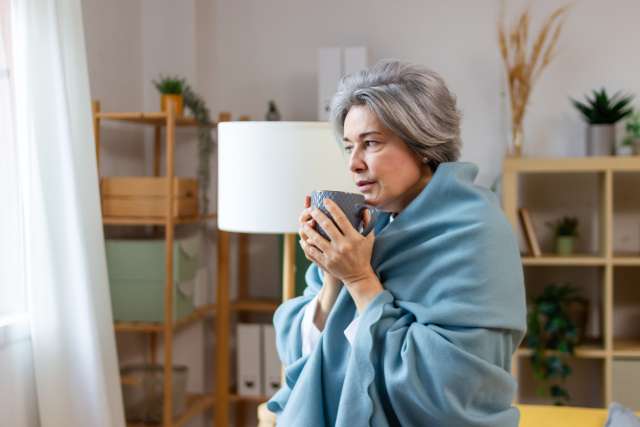
Feeling chilly or cold from time to time is part of being human. Typically, you throw on a sweater or jacket and go on with your day. But as you age, you may notice that you feel colder more often, and a light sweater isn't cutting it anymore.
Your normal body temperature doesn't change drastically with aging. However, thermoregulation — your body's ability to keep your core temperature steady — becomes more challenging. Physiological changes can impact how well your body:
- Recognizes the need for temperature regulation
- Generates heat
- Circulates warmth throughout your body
Additionally, aging increases your risk for conditions that cause you to feel cold. Identifying and treating an underlying condition, if there is one, may lead to a more stable body temperature.
4 age-related changes that affect body temperature regulation
Several age-related changes can contribute to poor thermoregulation, such as:
Your brain is less sensitive to temperature changes
Your body, just like your home, needs a "thermostat" to help it regulate internal temperature. The hypothalamus is the area of your brain that serves as your natural thermostat. It monitors sensory input and triggers appropriate responses, such as sweating to cool the body and shivering to generate warmth.
The problem is that your hypothalamus becomes less sensitive as you age. It may not react as it should to sensory input and adjust more slowly to external temperature changes.
Your body temperature is also meant to fluctuate by a degree or so over the course of 24 hours — it drops at night to facilitate deep sleep and then increases during the day. However, research shows that older adults don't experience those fluctuations the way younger adults do, and tend to have a lower core temperature.
Your body generates less heat
Many of your body's cellular processes produce heat. Metabolism — your body's ability to convert food into energy — is a major source.
As you age, your metabolism slows — nearly 1% each year — primarily due to:
A slower metabolism means less overall chemical activity in the body. The result is a decrease in your internal heat production.
Your body loses natural insulation
In addition to creating less heat, your body is losing heat more easily and aging skin plays a critical role in that loss.
Your skin has three layers:
- Outer layer (epidermis), responsible for protecting you against external elements
- Middle layer (dermis), which houses blood vessels and nerve endings, among other things
- Deepest layer (hypodermis), composed of fat that insulates the body
You retain all those layers throughout life. But as you age, the outer layer and deepest layer get thinner. When the outer layer — and the protection it provides — thins, it brings the blood vessels beneath it closer to the surface, where they are exposed to temperature changes. When the deepest, fatty layer thins, it no longer insulates the body well.
Your circulation decreases
When it's cold outside, your body must work to maintain its core temperature. To help with that, the blood vessels in your skin constrict (narrow) to reduce the amount of blood flowing to your fingers and toes. The goal is to decrease heat loss and direct blood flow — and warmth — to vital organs. This process is why your fingers and toes are typically the first body parts to feel cold.
However, as your body's ability to maintain internal temperatures becomes less efficient with age, this process of blood vessel constriction occurs more often. With less blood traveling to your extremities, you may increasingly feel cold.
Conditions that can cause you to be cold
While aging does impact your body's temperature regulation, it is not the only reason you may be feeling colder more than usual. Several conditions can affect body temperature, including:
Age is a risk factor for these conditions. Make sure to mention your temperature concerns to your primary care physician. They can help you rule out or identify a possible underlying condition.
Tips for staying warm as an older adult
The National Institute on Aging recommends taking steps to stay warm and encourage temperature regulation:
- Avoid or limit alcohol, which promotes the loss of body heat.
- Keep blankets accessible at home and in your car and add an extra blanket to your bed at night.
- Maintain a healthy weight since body fat can keep you warm.
- Prevent the loss of body heat through your head and extremities by wearing hats, gloves and slippers or socks when appropriate.
- Stay out of heavy wind, which can lower your body temperature quickly.
- Wear loose layers as the air between layers may help to keep you warm.
While portable space heaters can seem like a good way to stay warm, avoid using them. They can be a fire hazard and increase the risk of carbon monoxide poisoning.