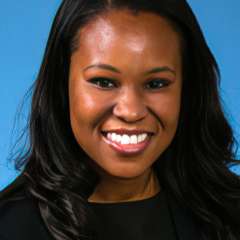

Colorectal cancer causes more than 55,000 deaths annually in the U.S. and is now the leading cause of cancer death among people younger than 50. These are staggering and heartbreaking numbers for a disease in which screening can often prevent cancer before it starts, says Eve Glazier, MD, host of "Medically Speaking" and an internal medicine physician at UCLA Health. She is also president of the UCLA Health Faculty Practice Group and a clinical professor at the David Geffen School of Medicine at UCLA.
As March is Colorectal Cancer Awareness Month, Dr. Glazier recently invited award-winning journalist and author Katie Couric and associate professor of Medicine Folasade May, MD, PhD, to discuss colorectal cancer on her podcast, "Medically Speaking." The episode is titled “Colorectal Cancer and The Couric Effect – Continued: Awareness to Action to Advocacy.”
Couric co-founded Stand Up To Cancer, which has raised hundreds of millions of dollars for cancer research, after her husband died of colorectal cancer at age 42 in 1998. Dr. May, a UCLA Health gastroenterologist, is an associate professor of medicine in the Vatche and Tamar Manoukian Division of Digestive Diseases at UCLA Health and an associate director of the UCLA Kaiser Permanente Center for Health Equity, where she conducts research on cancer prevention and control.
Together, they addressed the importance of colorectal cancer screening, the rise of early-onset colorectal cancer, lifestyle factors that can reduce risk, equity and access in screening and care, and the future of treatment and screening.
Screening saves lives – yet screening rates remain low
Dr. Glazier kicked off the segment by highlighting the alarming rise in colorectal cancer deaths, especially in younger adults. Screening can prevent cancer or catch it early, yet only 20% of people ages 45 to 50 are getting screened, despite new guidelines that recommend screening at age 45, Couric noted.
Dr. May explained that screening for colorectal cancer is done to either find polyps before they turn into cancer or to find cancer early enough to have a chance to cure it.
“We're mostly just looking for early signs of the cancer, but here we have the extra benefit that we can find polyps in the colon and take them out before they transform,” explained Dr. May, who is also an investigator at the UCLA Health Jonsson Comprehensive Cancer Center.
Colonoscopy remains the gold standard screening but is invasive and requires preparation and an escort to and from the procedure. Stool-based tests such as the fecal immunochemical test (FIT) and Cologuard offer easy, at-home alternatives with good accuracy for cancer detection.
“Not everybody can take a day off of work to get a colonoscopy,” Couric noted. “Not everyone has access to an escort. Some people are fearful of having a procedure where you're put asleep and an instrument is put into your backside. So, it's fortunate that we have other tests for people who fall into those categories and who want to be screened but don't think colonoscopy is for them.”
Dr. May emphasized that positive test results with stool-based tests require a follow-up colonoscopy for confirmation and treatment.
“A lot of my research in my lab at UCLA focuses on getting people in for that second step,” she said. “In that case, the colonoscopy is actually imperative. And that's when we check them for polyps or cancers that may have made the test positive.”
Many people delay or avoid screening, rationalizing that colorectal cancer doesn’t run in their family, Couric said. Yet 75% to 80% of colorectal cancers have no family history.
Couric noted that colorectal cancer is often asymptomatic, highlighting the need for screening to catch cancer in the early stages. However, possible symptoms such as blood in the stool, bowel habit changes, unexplained weight loss and persistent GI discomfort require medical attention.
“People need to be keenly aware of symptoms, particularly because we're seeing these cases prior to people turning the age of 45, which is the age of baseline screening,” Couric said. “So, it's just really important that you get screened when you're feeling well, which is so counterintuitive for people. They think, ‘Well, I feel fine, nothing's wrong with me.’ But that's the way this cancer operates. By the time you're symptomatic, oftentimes the cancer has advanced.”
Population shift means earlier screening
Dr. May noted that early-onset colorectal cancer rates are increasing sharply, which has prompted screening guidelines to change from starting at age 50 to 45.
“I think it's really important to recognize that this is a major shift,” Dr. May said. “When I was in medical school … medical students were taught that colorectal cancer was the disease you saw in people when they were 70. And it is not how we need to teach about colorectal cancer now. … I tell (my students) that if you see concerning symptoms … you need to be thinking about this disease even in a 30-year-old, a 40-year-old and a 50-year-old. And that epidemiologic shift, that population shift, is why the story is very different than it was in the 1980s and the 1990s.”
The shifts in how colorectal cancer is presenting has caused the medical community to change how they think about and manage the disease, said Dr. May. She presented three rules about how to protect yourself from colorectal cancer:
- Know your family history. If a first-degree relative (parent or sibling) has had colorectal cancer, begin screening at age 40 or 10 years before the earliest diagnosis in your family.
- If you don’t have a family history, begin screening at age 45.
- If you’re younger than 45, pay close attention to symptoms such as persistent abdominal pain, changes in bowel habits or ongoing GI discomfort.
Couric underscored the need for a global, multidisciplinary research “dream team” to study the causes for the rise of colorectal cancer in young adults. She said no single cause has been identified but it’s likely a complex mix of factors.
Current theories include a diet of highly processed foods, microbiome disruption, exposure to environmental toxins such as “forever chemicals,” antibiotic overuse and lifestyle factors.
Lifestyle changes can reduce risk
Dr. May outlined simple, manageable lifestyle changes that can help reduce the risk of colorectal cancer. They include:
- Limiting consumption of red meat to once a week
- Limiting alcohol consumption to weekends or a few times a week
- Eating more whole foods and fewer ultra-processed, packaged foods
- Exercising daily
- Reducing screen time
- Avoiding household products with harmful chemicals
- Reducing plastic use and microplastics ingestion
- Eating foods packaged in Earth-friendly containers
Dr. May emphasized encouraging actionable, realistic health choices that benefit overall physical and mental health.
“This is going to benefit everything from your brain to your feet … and from your cardiovascular to preventing other cancers,” she said. “I think that these are things that we all need to be teaching our children and our adolescents and also adopting for ourselves (that) are going to be good for the full body, mind and soul.”
Reducing disparities, increasing awareness
In her work with the UCLA Kaiser Permanente Center for Health Equity, Dr. May aims to ensure that everyone has access to screening, regardless of income, race, ethnicity, or where they live.
“A lot of our research is focused about working in community health centers and under-resourced settings or under-resourced parts of the country to make sure that people have access to screening tests,” she said.
Couric and Dr. May suggest that improving access to screening along with collaborative research and public advocacy are critical to reducing preventable deaths from colorectal cancer.
Dr. May noted that Couric’s televised colonoscopy in 2000 boosted screening rates by 20%. She calls it the “Couric Effect.”
“It was from such a pure place because I had learned so much during the course of Jay's illness,” Couric said about televising the procedure. “And I knew that people didn't feel comfortable talking about colorectal cancer. I knew that a lot of people couldn't even pronounce colonoscopy, much less get one. So, I felt like it would be criminal if I didn't share with this huge platform I had at the time all that I had learned about this disease, with an audience that trusted me and knew that it was coming from a very personal place.”
Couric aims to launch what she calls the “Couric Effect 2.0,” promoting the message that screening is easy, life-saving and accessible.
“To me, the plan is doing everything we can that's within our power right now,” she explained. “Obviously, being aware of symptoms, talking to doctors, making sure patients are keenly aware that if something's off, they need to pursue it with their doctors. But in the long term, I want there to be a test that is more accessible, less expensive, and that can be given to people starting at age 18.”
Couric is excited about research on blood-based liquid biopsies that could be administered during routine physical exams.
But challenges remain as to how to decide target populations, age, and managing follow-up procedures safely and cost-effectively, Dr. May said.
“Those are all areas of research that also need to be prioritized,” she said.
The conversation underscores a clear message: colorectal cancer is often preventable, and early detection saves lives. Increasing awareness, expanding access to screening and continuing research will be critical to reducing its impact.