
Healing, Empowering, and Liberating (HEaL) Trauma Program
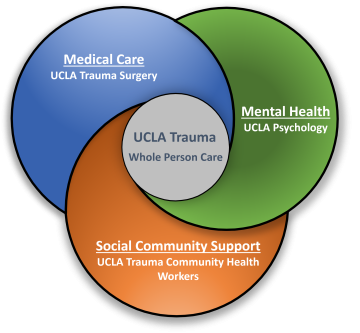
The HEaL Trauma Program (Healing, Empowering and Liberating) is a trauma-informed, whole-person care model embedded within the UCLA Health system to support patients across the full continuum of injury recovery — from hospital admission through postdischarge stabilization.
HEaL integrates clinical care with social and behavioral health support by combining Community Health Workers (CHWs), embedded psychology services and longitudinal follow-up to address the complex needs of trauma patients. The program focuses on improving recovery outcomes, reducing avoidable healthcare utilization and addressing the social determinants of health that shape long-term healing.
Project Leads
- UCLA Faculty PI: Catherine Juillard, MD, MPH
- Program Manager: Daniela Salinas, MPH, Erik Coll, MPH, BSN, RN, Katherine Hurley, MSN, RN, CEN
Staff
- Theresa “TT” Tobias – Community Health Worker
- Paige Mahan – Community Health Worker
- April Thames, PhD – Professor-in-Residence, UCLA; Chief of Medical Psychology/ Neuropsychology
- Charla Megan Felix, MSN, NP-BC – Acute Care Nurse Practitioner
- Christine Quinn, NP, AGACNP-BC, FNP-BC – Acute Care Nurse Practitioner
- Mckenna Griffith, MSW, LCSW – Clinical Social Worker
- Ariana Flores – Trauma Administration
- Maria Hernandez-Martinez – Trauma Navigator Support
- Briana Britton, MD – Surgical Critical Care and Trauma Fellow, UCLA; PASE Research Trainee
- Garrett Salzman, MD, MS – Resident Physician, UCLA; PASE Research Trainee
- Emily Jones, MD, PhD – Resident Physician, UCLA; PASE Research Trainee
- Doris Gonzalez, – MD Candidate, UCLA; PASE Research Trainee
- Jennifer No, – MD Candidate, Rush Medical Student; PASE Research Trainee
- Brittany Robinson, MD, MPH – Resident Physician, UCLA; PASE Research Trainee
- Serge Ngekeng, PhD – PASE Researcher (Cameroon Based)
Background
Trauma can have lasting physical, emotional and social impacts. Many patients experience challenges after injury, including difficulty accessing resources, navigating services and managing mental health symptoms. Social care needs — such as housing instability, food insecurity, transportation barriers and lack of access to community services — are not medical conditions but significantly affect health and recovery. In addition, trauma increases the risk of mental health conditions such as post-traumatic stress disorder (PTSD), which can impact daily functioning and long-term well-being if left unaddressed.
The HEaL Trauma Program was developed to bridge these gaps by integrating social care, mental health support and trauma-informed practices into the recovery process at an inpatient level and continuing services at the outpatient level.
Vision
To deliver equitable, trauma-informed and whole-person care that supports healing beyond injury, ensuring patients have the resources, support and connections needed to recover and improve their quality of life.
Mission
To provide trauma-informed, whole-person care that addresses both medical and nonmedical needs, supporting recovery, preventing further trauma and improving overall quality of life.
Our Goals
The HEaL Trauma Program is designed to deliver patient-centered, whole-person care that addresses both medical and nonmedical factors influencing recovery. The program focuses on identifying and addressing social care needs, developing individualized care plans aligned with patient goals, and providing longitudinal support beyond hospital discharge.
A core component of HEaL is the integration of mental health and well-being into trauma recovery. This includes screening for trauma-related mental health symptoms, connecting patients to appropriate services, and promoting early intervention to prevent long-term psychological effects.
HEaL also emphasizes care navigation and resource connection by supporting patients in accessing social services, benefits and essential resources such as housing, food, transportation and employment support. These efforts are complemented by strong health system integration, including embedding Community Health Workers into trauma care delivery, incorporating trauma-informed approaches across care teams, and improving coordination between clinical, behavioral health and community-based services.
Core Program Components
Community Health Worker (CHW) Model
CHWs play a central role in supporting recovery by assessing nonmedical needs, connecting patients to community resources, assisting with benefits and service navigation, and providing ongoing follow-up after discharge.
Social Care Integration
HEaL addresses social care needs — nonmedical factors that influence health and well-being — including housing, food access, transportation and social support, ensuring that patients have the resources necessary for recovery.
Mental Health & PTSD Screening
HEaL integrates proactive mental health support, recognizing that trauma can lead to lasting psychological effects. Early identification and connection to care are key components of the program.
Postdischarge Mental Health Screening and Follow-Up (Cipher Health)
As part of its commitment to whole-person care, HEaL integrates automated post-discharge outreach to identify trauma-related mental health needs and support early intervention.
Following hospital discharge, patients receive a phone call or text message through an automated system that screens for symptoms of post-traumatic stress disorder (PTSD). Patients who screen positive or request additional support are connected directly to a Community Health Worker for follow-up, resource navigation and linkage to mental health services.
This approach enables timely identification of mental health needs, improves access to care and extends support beyond the hospital setting. It also generates critical data on patient engagement, symptom burden and follow-up care utilization, strengthening HEaL’s role as a platform for research on trauma recovery and health system innovation.
Research Focus Areas
HEaL serves as a platform for advancing research across trauma recovery, health equity and health systems innovation. Research efforts examine mental health outcomes following injury, including PTSD screening, patient-reported symptoms and recovery trajectories, as well as the effectiveness of early intervention and follow-up support.
The program also investigates the role of social determinants of health in recovery by assessing the distribution of social care needs, evaluating the impact of Community Health Worker interventions, and identifying barriers to accessing services after discharge.
In addition, HEaL evaluates healthcare utilization and system-level outcomes, including emergency department revisits, hospital readmissions, length of stay and avoidable utilization. These efforts are complemented by implementation and health systems research focused on integrating trauma-informed care into clinical workflows, defining the role of CHWs in acute care settings, and assessing the scalability of whole-person care models across health systems.
Data and Methods
HEaL supports mixed-methods research through the integration of clinical, social and behavioral health data collected across the continuum of care. Findings from the program are used to inform health system practices and policy, identify disparities in trauma recovery and access to care, and develop scalable models for trauma-informed, whole-person care.