
In Memoriam: Susan Perlman, MD, Longtime UCLA Neurology Leader in Ataxia and Huntington’s Disease Care
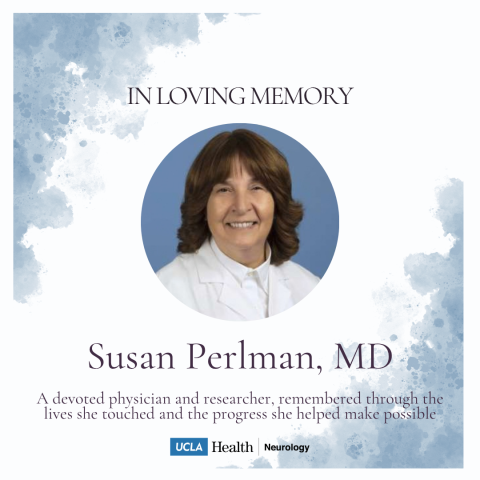
The UCLA Department of Neurology is deeply saddened to share that Susan "Sue" Perlman, MD, passed away on September 30, 2026.
Dr. Sue Perlman spent her career caring for people with progressive neurologic diseases, diseases that take away movement, coordination, independence, sometimes thought and personality. Many had inherited diseases that traveled through families. Medicine could describe their course long before it could alter it. Sue built one of the largest programs in the country for these patients and carried with her a conviction that shaped her care: “there is always something that can be done.”
Dr. Perlman was one of the first two women to train as neurology residents at UCLA, a pioneering path for so many. In the early 1980s she began concentrating on inherited neurologic disorders, years before the Human Genome Project and long before a genetic test could settle many of the questions brought into her clinic. A pedigree, a neurologic examination and years of watching a family were often the available technology. She learned these diseases in that era and then worked through their later molecular identification, the growth of clinical trials and, eventually, therapies directed at the biology itself. Few physicians accompany, actually pioneer, a field across that much distance.
Patients followed her. So did their families. The UCLA Ataxia Center alone grew to care for more than 2,500 patients and families and evaluate 150 to 200 new patients each year. Sue also led the UCLA Huntington’s Disease Society of America Center of Excellence and the UCLA Neurogenetics Clinical Trials program. She developed clinical trials in Friedreich ataxia, other ataxias, Huntington disease and multiple system atrophy, helping bring disorders once observed largely through natural history into an era of international drug studies and gene-therapy trials. Some families remained with her for decades. She eventually found herself caring for later generations of families she had first met much earlier in her career.
The numbers describe the program but not the physician. Sue might schedule her first patient at seven in the morning because seven was easier for the patient. She stood outside her examining room waiting to greet people in the hallway. A patient’s troubles did not have to fit neatly inside the neurologic diagnosis to earn her attention. Colleagues remembered that people with incurable diseases would arrive discouraged and leave with another plan. Sue had listened. Something could still be treated, adapted, arranged or tried.
Her hope was not just optimism. It was work. In her post-polio clinic, Sue returned repeatedly to groups of polio survivors to discuss pain, fatigue, swallowing, exercise, braces, rehabilitation and whatever new research might matter to them. She addressed care groups and took questions. A disease without a cure still contained a great deal of medicine.
This was also how Sue approached the medical system. As Chair, I met with her from time to time to review clinical performance, finances and the other machinery that accompanies modern healthcare (as Chairs must). Sue cared for patients who could consume time and resources without producing particularly attractive healthcare metrics. With a life-long neurodegenerative disease, some had little ability to pay for the complexity of the care they required. Healthcare systems are fond of averages; Sue’s patients rarely were. She kept advocating for the patient in front of her. The system had to find a way to catch up.
After the untimely death of her husband, Sue raised eight children as a single parent while building this career. Her family remained exceptionally close and was her greatest priority. Her family note that Sue Perlman had a remarkable gift for balancing her many responsibilities while ensuring that none of her children ever felt neglected or lacked her love, care, and attention. She enlarged her house as her children grew, making room for their lives as they changed. Many of us knew little of this story; Sue kept this part of her life close. The house she enlarged for her children is a direct image of Sue Perlman’s career: she kept making room for other lives.
Neurology places physicians close to losses that cannot always be repaired. A person may lose the steadiness of a hand, the ability to walk across a room, the ease of swallowing, judgment, memory or independence. Scientific progress matters enormously, and Sue spent much of her career pushing it forward. But Sue recognized the important element, the human poetry, that is still present even in neurological disease, that the worth of a life cannot wait for the next therapy.
In Winter Hours, the poet Mary Oliver walks from a house made hard and hopeless by winter to the natural uplift of tide pools and pine woods, and finally to “a thousand unbreakable links between each of us and everything else.” We are “each other’s destiny.” Sue cared for people whose futures had been narrowed by disease. She found what remained possible: a symptom relieved, independence preserved, a family prepared, a clinical trial, a new therapy coming into view. Some families traveled with her for decades, across generations and across an era in which diseases once known only by their clinical course became genetically defined and, increasingly, treatable. Hope changed shape, but it never disappeared.
Sue made room for that hope, in her clinics, in the programs she built, in the lives of patients and families. As a physician, her gift was to see possibility where illness had made the future seem small.
Sue Perlman recognized that there is always something that can be done for another. We are each other’s destiny.
S. Thomas Carmichael, M.D., Ph.D.
Professor and Chair
Department of Neurology
Geffen School of Medicine at UCLA
Consider honoring Dr. Perlman with a memorial gift to help carry her vital work forward.