
Spotlight on Pediatric Anesthesiology
Spotlight on Pediatric Anesthesiology
Written by Lisa Lewis, MS
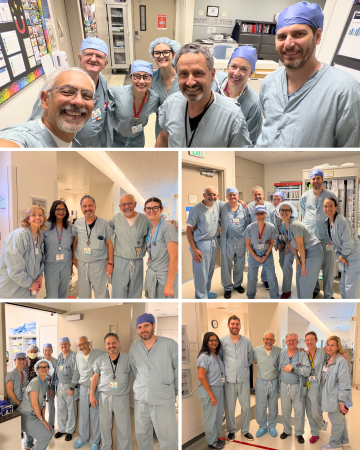
In pediatric anesthesiology, the variety of settings is broader and at times more challenging than for adults. The patients, who may weigh as little as 400 grams, are often fragile. Depending on their age, direct communication is not always possible, and even when it is, there is always a second party involved: the patient’s parents.
Those aspects are also what make the specialty so rewarding, according to the pediatric anesthesiologists in the UCLA Department of Anesthesiology & Perioperative Medicine (DAPM).
“It’s an incredible responsibility and privilege to take care of somebody’s child, and to have them trust you with that responsibility,” said Lindsay Brown, MD, Assistant Program Director for the Pediatric Anesthesiology Fellowship.
“I like trying to make the kids’ and the families’ days just a tiny bit better, if I can,” said Theodora (Theo) Wingert, MD. “For most parents, having a child undergo surgery is one of the worst nightmares they can imagine. So if there’s anything that I can do to make that better, that's what I strive for.”
Patients plus parents
Other than the rare emergency cases, that work actually starts the night before a scheduled procedure, noted Marc Iravani, MD. “I make a call to the parents and answer any questions. I’ve found that to be very effective – when they see me in the morning, we’ve already established contact, so their anxiety is at a lower level, and that translates to the child’s anxiety as well.”
When meeting with the families prior to the procedure, Dr. Iravani is mindful of how he interacts with both the parents and the patient.
“I take a minute to calm myself before I meet a new family,” he said. “The tone of voice is crucial, your posture, everything.
“As you enter the room to meet the parents and child, you can sense what level of anxiety or apprehension they have,” he said. “I take their questions before I start my own questioning – until they have their own questions answered, they won’t really be hearing what you tell them.”
Lisa Lee, MD, characterized the process as a bit of an art form, and one that varies based on the age of the patient. “A two-year-old is always going to be afraid of being separated from their parents, period,” she noted. “In combination with medication, we’re often distracting them to help get them into the operating room.”
That frequently involves a Child Life Specialist, and even the occasional song. “We have a fellow, Brandon Sumida, who will sing to them on the way to the operating room,” Dr. Lee said. “Most of us aren’t as musically talented, but we will still do it if the occasion calls for it.”
National recognition
In 2024, the American College of Surgeons granted UCLA Mattel Children’s Hospital the prestigious Level I Children’s Surgery Verification. Mattel is just one of five hospitals in California – and the only one in Los Angeles – with this designation.
“It’s quite an accomplishment to get this as a hospital within a hospital, rather than as a freestanding children’s hospital,” noted Ihab Ayad, MD, Chief of the Pediatric Anesthesiology Division. “From the ED to the anesthesia providers to the surgeons to the post-operative period, all hands on deck came together to get this certification.”
Research and emerging issues
In 2022, Dr. Ayad implemented a methodology for risk-stratifying perioperative congenital heart disease patients to determine the appropriate level of care. This built on the risk stratification process already in place for the pediatric surgical home, he said, which covers all pediatric patients scheduled for procedures at UCLA.
He and Dr. Wingert also worked together on a study examining intraoperative events in children undergoing cardiac MRIs. “Not many people – even pediatric cardiologists and the people ordering these scans – realize that these patients typically need general anesthesia with a breathing tube,” Dr. Wingert said. “These are very, very high-risk patients.”
Unlike in other settings, a video laryngoscope cannot be used in an MRI, she noted. “All of the monitors are completely different because they have to be MRI-safe. All of the infusion pumps are completely different. We can’t bring ultrasound, we can’t place lines easily, and we have to be about 20 feet from the patient the entire time while they’re doing the actual imaging. It’s a fairly austere environment.”
Dr. Wingert recently received both a National Institutes of Health (NIH) grant and a Foundation for Anesthesia and Education Research (FAER) grant to fund her work on using artificial intelligence and physiologic waveform data to improve perioperative risk prediction and outcomes.
The NIH grant, which she received in March 2026, provides funding for the next four years. “I don’t think I would have been able to apply for these major grants if I hadn’t had the support of the pediatric anesthesia team,” Dr. Wingert said.
“A lot of the research I do is to promote pediatric safety in perioperative care,” she added. “We have some automated algorithms I created that are a real-time clinical support tool allowing children with congenital heart disease who are undergoing procedures to have their care appropriately coordinated.”
UCLA is fairly unique in having implemented machine-learning models into the EHR so physicians can actually use them, she noted.
Dr. Lee’s research has also focused on perioperative outcomes, looking specifically at various respiratory complications. One published study examined risk factors associated with difficult mask ventilation in pediatric patients, while a current related study investigates respiratory complications on the day of surgery related to environmental factors such as air pollution.
“My research really started during my fellowship year, under Wendy Ren,” Dr. Lee said. “We were evaluating when it would be safe to take a child under anesthesia who has recently had a cold. That’s a question a lot of peds anesthesiologists face, because there are risks to putting them under when they’re sick.”
Given that many pediatric patients don’t come to the operating room with an IV in, she explained, “the in-between time when we don’t have an IV or a secured airway can be kind of dicey, so kids who are sick will sometimes get canceled.”
After presenting her work at a conference, Dr. Lee met other pediatric anesthesia researchers and continued to work on related projects, which eventually led to being named as an Associate Editor at the British Journal of Anaesthesia last fall.
The division also focuses on emerging issues, including a Venezuelan mitochondrial genetic variant that can cause severe complications. “That’s something that’s been more of a focus recently,” Dr. Brown said, “including how to screen patients, and how to provide the safest anesthetic for them.”
Additional considerations for a unique population
“A patient under anesthesia is vulnerable, and you are the advocate for them,” Dr. Iravani said. “But I would say that’s even more so in pediatrics, because even if they’re awake, they’re vulnerable.”
Patients in the NICU are “probably the trickiest,” said Dr. Brown, “especially the micro-preemie babies where we just don’t even have the research to fully understand their hemodynamics and what’s optimal for them. Any milligram or microgram of error can make a difference when the baby weighs one kilogram or even less than that. There was a baby recently who weighed .6 kilograms.”
Despite being fragile, however, pediatric patients are also comparatively more resilient, Dr. Trieu noted. “They do go down fast,” she said, “but they also bounce back fast.”
In many cases, pediatric patients are receiving anesthesia in a non-OR setting, which requires additional planning.
A child who is too sick to go to the operating room might be treated in Interventional Radiology, which is less invasive, Dr. Brown noted. “From a surgical perspective, it’s lower risk, but from an anesthetic perspective, it might be higher risk just because you’re not in the OR,” she pointed out.
Children are also more likely to require anesthesia for an MRI, given that they may not be able to hold still. “In the operating room, you usually have the head of the bed right next to you, whereas for an MRI, it’s in a machine farther away,” Dr. Brown said. “You need to know where everything is and be able to direct someone else to be able to get it for you if you’re with the patient.”
Lung isolation can also be more challenging in children than in adults, Dr. Lee pointed out. “On the adult side, they mostly use double-lumen tubes,” she said. “For peds patients, because of size, we have many different techniques, ranging from just pushing the tube down one side, or using bronchial blockers, or, if the patient’s big enough, a double-lumen tube.”
On the pain management side, the division now provides awake spinal anesthetics for infants up to six months of age who are undergoing lower abdominal procedures of an hour or less, Dr. Ayad said. Infants and children may also receive neuraxial blocks for postoperative pain control.
Sharing expertise
Members of the division regularly participate in medical missions around the globe. This year marks the third annual trip to Armenia, noted Dr. Ayad, who participated in the inaugural mission and will travel there again next month. The trips have been organized by Shant Shekerdemian, MD, Interim Chief, Division of Pediatric Surgery.
Last year’s trip also included Dr. Trieu and Mariesa Buhl, pediatric anesthesiology nurse practitioner; this year will include pediatric anesthesiology fellow physicians Dr. Sumida and Justine Liang, MD.
Dr. Trieu has also done medical missions to El Salvador and Peru for cleft lip, cleft palate, and microtia reconstructive surgeries, and will soon make her third trip to El Salvador.
Tiffany Williams, MD, PhD, recently returned from El Salvador, and was also in Jordan a few months ago to help with pediatric cardiac surgery there.
Other division members who provide services globally include Michelle Harvey, MD, who will soon travel to Honduras to assist with pediatric surgery, and Swati Patel, MD, who travels to Peru frequently and has previously provided care in India and elsewhere.
Dr. Iravani, whose most recent trip was to Ethiopia as part of UCLA’s Global Health program, has also traveled to Guatemala, Honduras, Mozambique, and Armenia to provide anesthesia training and patient care.
Closer to home, Dr. Lee and Dr. Harvey co-teach a course for first-year UCLA medical students to provide them with foundational knowledge for practicing medicine, and Dr. Iravani teaches various undergraduate seminars related to the history of medicine.
Intra- and interdepartmental teamwork
Dr. Brown noted that the division is excited about its two newest members, Amélie Delaporte, MD, who was most recently a pediatric cardiac anesthesiology fellow, and Justine Liang, MD, who is currently a pediatric anesthesiology fellow and will officially join the division in October.
“We’re very grateful and excited to have them on the team,” Dr. Brown said.
Within the division, pitching in is quite common, she noted. “You always have someone available to provide an extra set of hands. Sometimes, people will just see on the board that there’s a really sick case and will show up.”
That can even be the case with healthy patients, she said: “You can get these really healthy but chunky babies who are very difficult to find an IV on and might require extra hands, because at the same time you're getting the IV, someone has to be holding the mask and making sure the baby’s breathing.”
The division also appreciates being able to draw on the expertise of other members of the department if they’re handling a unique pediatric case, Dr. Ayad said, and are happy to provide the same assistance for adult cases. “Our primary job is peds, and our secondary job is to help in any other way we can,” he said. “We’re part of the bigger department, and we are happy to be part of it.”